

Pilates as a form of support for herniated discs
In conversation with Olga Keller
Back pain is one of the most common ailments of our time, and a herniated disc can severely limit daily life for those affected. Many people are looking for ways to stabilize their spine and reduce pain over the long term. One exercise method that is increasingly recommended for this purpose is Pilates.
One expert in this field is Olga Keller, founder of the Strongback Pilates studio in Zurich-Altstetten. As a Pilates instructor, she brings not only a solid background in classical Pilates training but also over two decades of experience as a registered nurse in fields such as emergency medicine, cardiology, and home care. This combination of medical expertise and movement knowledge shapes her work with her clients.
At her studio, she focuses particularly on personalized training to strengthen the back and core muscles. The goal is to improve flexibility, stability, and body awareness—key factors for people with back problems. In the following interview, Olga Keller explains how Pilates can help with a herniated disc, which exercises are beneficial, and what those affected should pay special attention to.
Olga, you’ve been working with people who have back problems for many years. How often do you encounter people with a herniated disc during training?
With a confirmed diagnosis? On Monday, Tuesday, Wednesday, Thursday, and Saturday. Please don’t be alarmed—I’m working at the studio on those days (wink) and have just increased my capacity, so I’m available even more at the studio. People with herniated discs (HD) hear good things about Pilates and come to training for exactly that reason. More and more physical therapists and medical professionals are also happy to recommend Pilates. It’s clear to everyone diagnosed with a herniated disc: “I need to do something good for my back on a regular basis.”
It’s interesting that more and more young people with back pain (which doesn’t necessarily have to be a herniated disc) are doing Pilates. This is certainly linked to the popularity of Pilates and the mindset: “I like to do my own research.”
A herniated disc comes as a shock to many people at first. Can you briefly explain what happens in the body when this occurs?
Well, first of all, anyone “with a spine” should know: Not every herniated disc causes pain or symptoms. Herniated discs can be present but remain asymptomatic because they have enough space around the vertebral body and do not press on a nerve. That is what causes pain and other symptoms, such as tingling in the leg or even sensory loss like a sudden numbness in the leg. These people seek medical help or physical therapy fairly quickly.
In a herniated disc, the extremely useful and soft intervertebral disc (IVD) is pushed out over the edge of the vertebral body. The poor disc is pressed against a spinal nerve by the pressure between two vertebral bodies. The nerve sends a message to the brain saying, “I’m being crushed,” and signals pain as a warning sign.
“I just have weak muscles,” say most of the people who come to me for training. The good news is that there’s something you can do about it. Everyone has muscles that can and must be trained; otherwise, they would collapse and be unable to hold themselves upright, stand, or walk. Your musculature is your functional full-body suit (like a knitted suit) that is further woven together through Pilates and supports the entire spine. You need this support all the more when “collapses” such as a herniated disc in the spine are a threat.
In the past, rest was often recommended for back problems. Today we know that targeted exercise is important. What role can Pilates play in the case of a herniated disc?
Very important: Pilates takes on the role of follow-up training after a diagnosis and treatment (therapy, surgery) with physical therapy. It’s different if someone has known the diagnosis for a long time and is receiving therapy; that person can certainly visit a nearby Pilates studio afterward.
Complete rest—or even bed rest—is totally out of style as a recommendation. Unless, of course, the person is in an acute phase and can only move to meet basic needs, such as using the restroom, thanks to the effects of pain medication. They intuitively rest, and this intuition is “essential for movement.” Physical therapists and medical professionals recommend movement, depending on the symptoms. This means: Patients perform movements (or exercises) that their pain allows. And here, intuition is key. Even if it’s just a walk.
Which aspects of the Pilates method are particularly helpful in stabilizing the spine after a herniated disc?
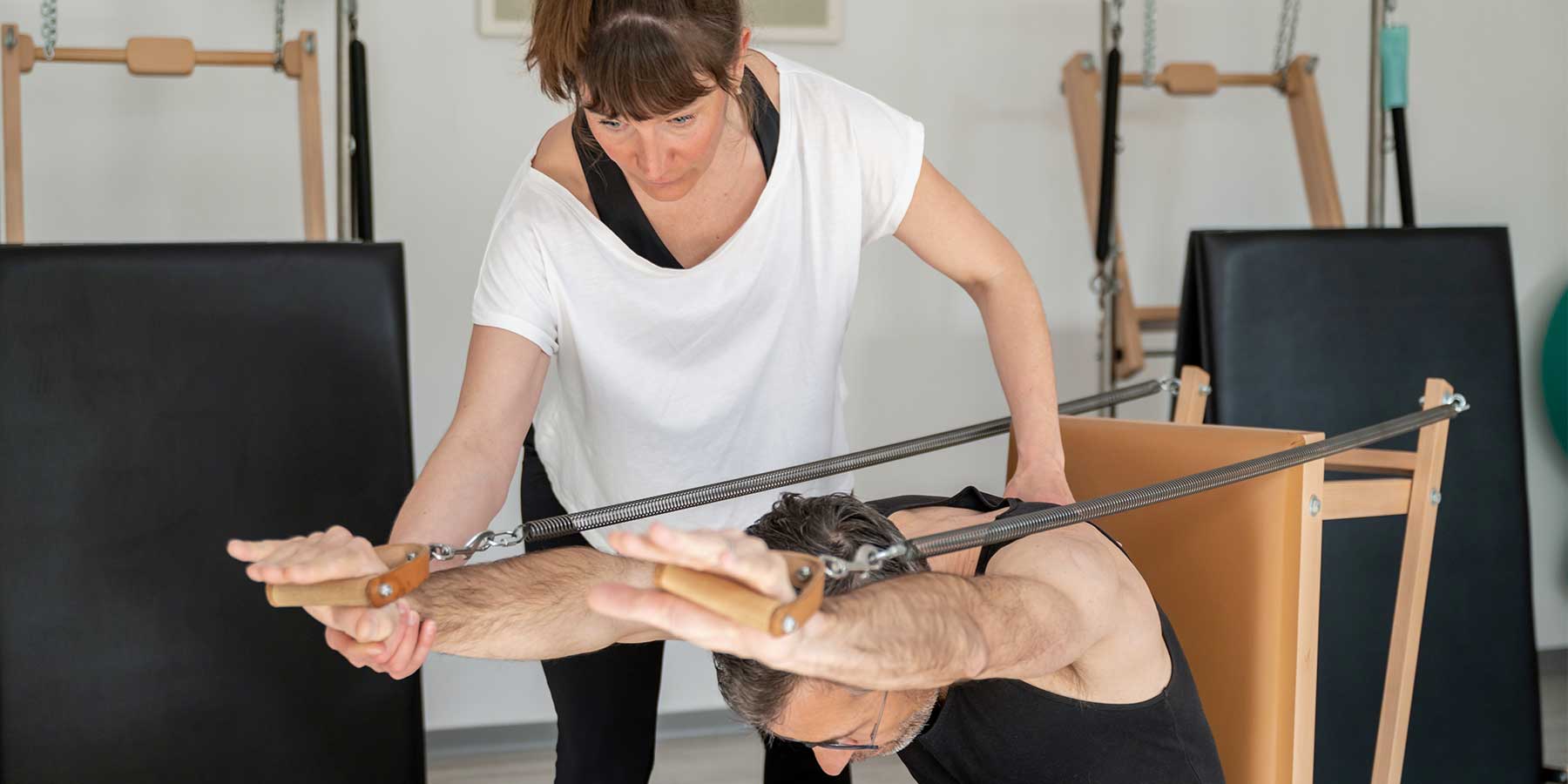
I really like this question! The key to the Pilates method is the use of steel springs. On all equipment, except the mat, you work with these steel springs—using your feet, legs, hands, and arms—to build muscle and stabilize the right areas. This also strengthens the abdominal, core, and back muscles. Muscles that have been dormant for a long time suddenly wake up.
Pilates places great emphasis on the core. Why are strong core muscles so crucial for a healthy spine?
Well-trained and strong backmusclesare EVERYTHING. Let’s consider our spine as the (body’s) center. Let’s imagine it as a “well-functioning” coat rack. A lot hangs from the coat rack: the head, arms, hips, and legs. It has to do a lot of work!
Many people who have suffered a herniated disc wonder when they can start exercising again. When is Pilates appropriate and safe?
People often begin Pilates during the final phase of physical therapy or immediately afterward. That is exactly the right time to start. At this point, I can work very effectively with them—training, not treating. The person knows their weak spots, has regained confidence, and understands: “I want to and must strengthen and support my back.” Pilates trains the muscles in the right places, creates space, and thereby relieves pressure on the entire spine and thus the intervertebral disc.
How do you adapt Pilates exercises when someone with a herniated disc comes to you for training?
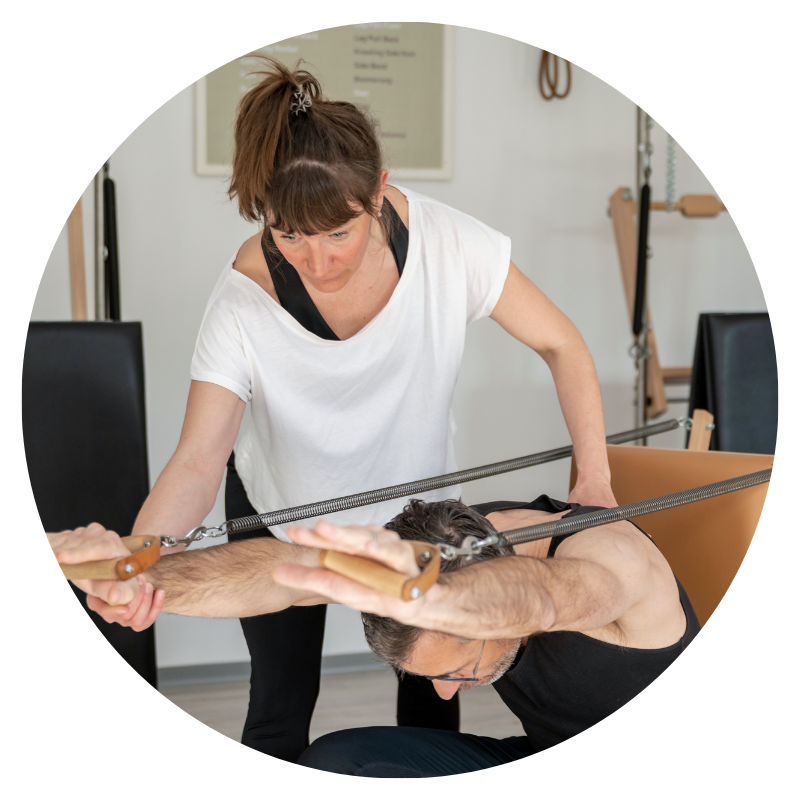
I always prefer to see these individuals (unless they come as a pair) in a one-on-one session. I usually start the first Pilates session while lying down. Lying down reduces muscular tension and shifts the body’s weight. So I take advantage of lying on the apparatus and start with a few exercises using the steel springs. I adjust the springs to the person’s condition and symptoms, and quickly assess what the body is capable of. The person quickly tells me what they can’t do. I want to see what they can do, not what they can’t.
Are there simple principles or exercises from Pilates that people with back problems can easily integrate into their daily lives?
Oh yes, these three: Breathing: Breathe with the movement, whether on the mat or on equipment, in a way that engages the diaphragm. Shallow breathing or holding your breath blocks movement. Concentration: Use your arms and legs for exercises with the mental image that “they are growing out of your back
.” The flow of movement is crucial: rhythmic movements—moving as if to your favorite music. That’s how rhythm is created! Never hold a movement or stop it altogether, otherwise the exercise’s effect on the muscles is interrupted.
Many people develop a fear of movement after a herniated disc. How do you address this anxiety during training?
These fears are also justified and are part of my job. Very important: I need to see the body in motion. That’s why I start with all participants with one-on-one training on the Reformer or Cadillac. On these machines, I can adjust the tension of the steel springs to be lighter or heavier. Participants can transfer the weight of their legs onto the springs, allowing them to move without pain or fear. From experience, I can recognize insecurities through body language. Yes, back pain has its own body language.
At the end of every class, I always—and I mean always—see relaxed and pleasantly surprised faces. A medical diagnosis can feel like a nightmare etched into the mind, which is why empathetic communication and effective movements are absolutely, absolutely essential. And that’s what I do every day at the studio. Good movement for better mental images.
If you could give people with back problems just one piece of advice for their spinal health—what would it be?
Movement. Complex but beneficial movements. Moving with joy and effectiveness. This type of movement can be truly motivating! And sometimes—not always—it can be Pilates. :o)))
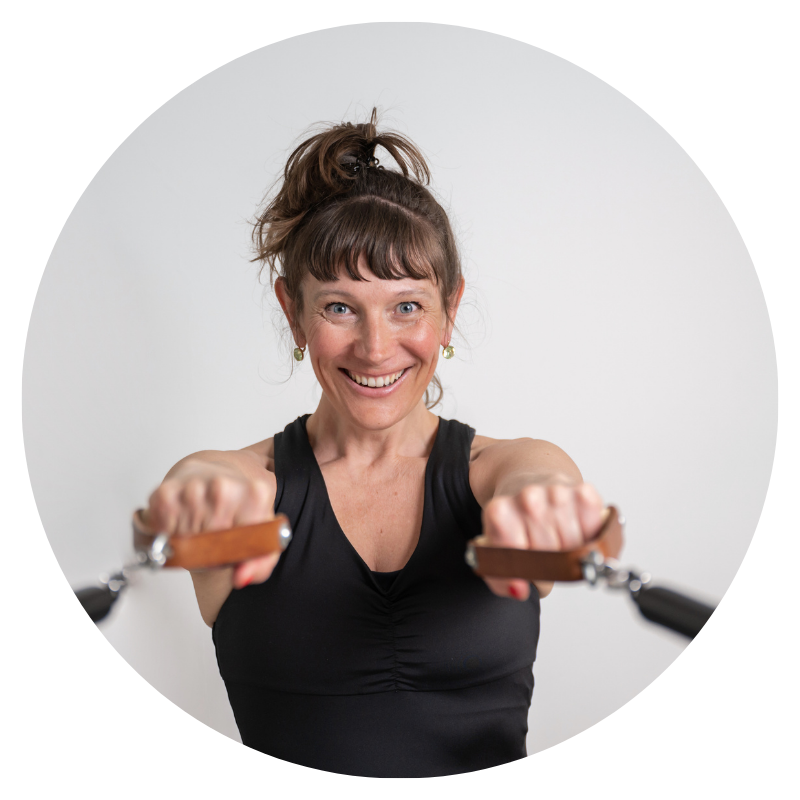
Olga Keller, founder of the Strongback Pilates studio in Zurich-Altstetten.