

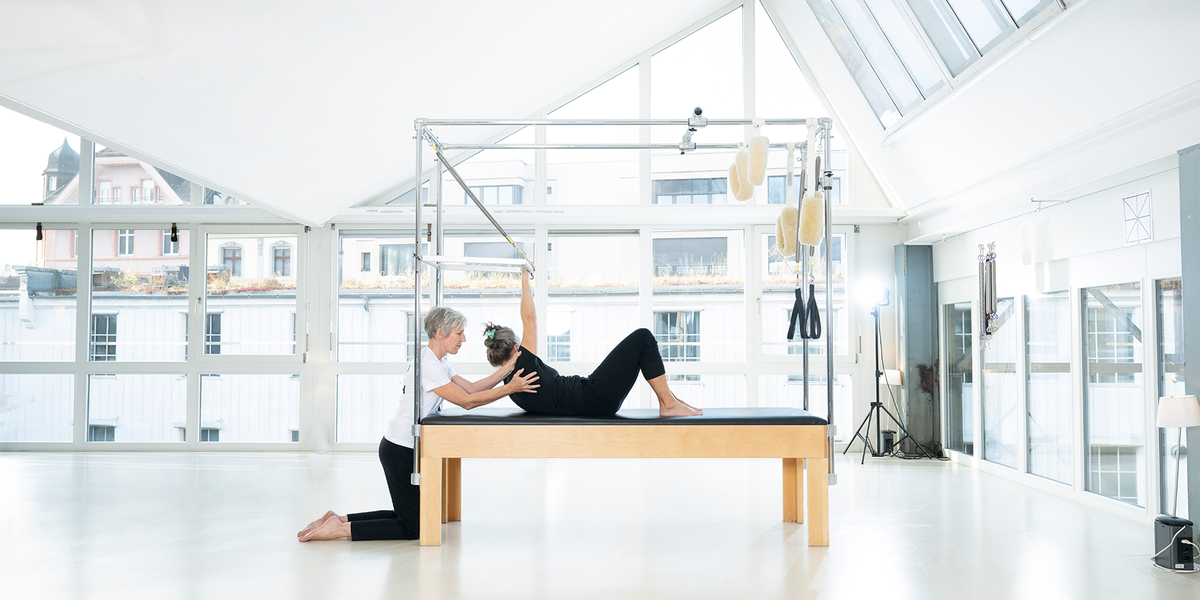
Achilles Tendon Rehabilitation with Pilates
Improve movement quality, strength, and endurance.
Achilles Tendon Problems: Why Pilates Equipment Makes a Difference in Physical Therapy Rehabilitation.
Pain in the Achilles tendon is often caused by overuse. It can be particularly noticeable when running, jogging, or participating in other sports. But even in everyday life, pain and stiffness can limit your range of motion. Typical symptoms include pain upon first movement in the morning when getting out of bed or after sitting for a long time, as well as pain during prolonged activity. There may also be swelling or thickening of the tendon and tenderness to the touch.
An Important Distinction
First, it is crucial to determine which structure is affected: the Achilles tendon itself or the surrounding tissue? And which part of the Achilles tendon is affected?
This distinction determines which types of stress and ranges of motion (stretching) are appropriate. It is crucial to gradually and specifically reacclimate the affected structure to stress—while closely monitoring how it responds to each type of stress.
We therefore focus our treatments primarily on active, load-based approaches. We use passive measures (e.g., taping, connective tissue massage, prototherapy) as complementary therapies.
A sore Achilles tendon doesn't like pressure
The Achilles tendon responds not only to tension but also to compression. Consequently, a tendon that is already painful or irritated may react sensitively if, in a foot position where it is under significant tension, it is additionally compressed by the heel bone (calcaneus).
For this reason, traditional stretching exercises for the calf muscles—such as the typical stretch for the gastrocnemius muscle, in which the knee is pushed well past the foot—are not ideal in every phase of Achilles tendon rehabilitation.
That doesn't mean you should never stretch your calf muscles. Rather, it depends on where and how the strain is applied.
This is exactly where the strength of training with Pilates equipment lies
With Pilates equipment, we can adjust the position of the foot very precisely. This allows us to design the exercise so that the Achilles tendon is exposed to as little unwanted compression as possible, while at the same time the entire muscle chain can be specifically trained or stretched.
On the Reformer, we can individually adjust the position of the foot on the footbar and use the springs to select a resistance level that is significantly lower than body weight but can still simulate a challenging, functional movement while standing. This allows us to carefully control the intensity early on and gradually increase it as we progress.
The other Pilates machines (Trapeze Table, Chair, Barrel) also offer nearly endless possibilities for variations.
In doing so, we do not view the Achilles tendon in isolation. The movement can extend from the calf, through the knee and hip, all the way to the trunk and into the arms . This transforms a localized treatment into a holistic rehabilitation process that can be tailored to the individual.
Regula Akos. Licensed Physical Therapist / Polestar Pilates Certified Practitioner
Bibliography:
1. Cook JL, Rio E, Purdam CR, Docking SI. Revisiting the continuum model of tendon pathology. British Journal of Sports
Medicine. 2016;50(19):1187-1191.
2. Koc TA Jr, Bise CG, Neville C, et al. (2023). Heel Pain — Plantar Fasciitis: 2023 Revision (Clinical Practice Guidelines Linked to the ICF). Journal of
Orthopaedic & Sports Physical Therapy.
3. Sivrika AP, Papadamou E, Kypraios G, Lamnisos D, Georgoudis G, Stasinopoulos D. Comparability of the Effectiveness of Different Types of Exercise in the Treatment of Achilles Tendinopathy: A Systematic Review. Healthcare (Basel). Aug. 11, 2023;11(16):2268.
4. Cook JL, Stasinopoulos D, Brismée JM. Insertional and mid-substance Achilles tendinopathies: eccentric training is not for everyone—updated evidence on nonsurgical management. J Man Manip Ther. July 2018;26(3):119-122.